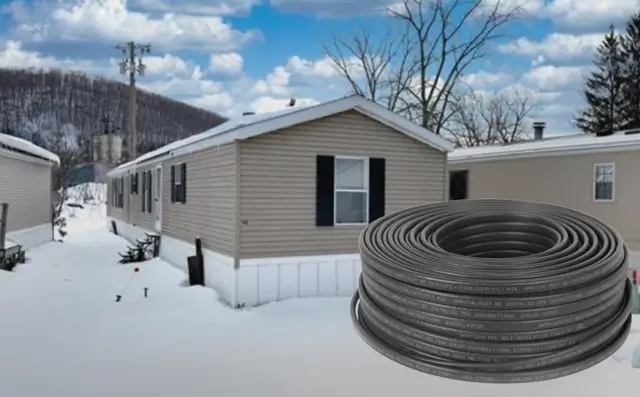
Choosing the best heat tape for a mobile home comes down to reliability, safety and the ability to perform in severe cold. Mobile homes have more exposed plumbing than site-built houses which means the right cable can make the difference between a trouble free winter and a costly pipe repair.
Several manufacturers offer solid options for this type of freeze protection. Among the products most often recommended by professional installers and homeowners, two stand out for consistent performance in cold climates: Heat Tape PRO by Radiant Solutions and Frost Guard by Raychem. Both are self regulating cables, a technology widely preferred for mobile homes because it automatically adjusts heat output and can safely overlap on itself.
Heat Tape PRO is frequently noted for its strong feature set which includes six to ten watts per foot of output, a long power cord, an LED power indicator and a ten year warranty. Frost Guard tends to appeal to homeowners looking for a dependable cable with a long track record and a familiar name in the freeze protection category. Each option has strengths and the better choice usually depends on the layout of the plumbing and how severe the winter conditions are.
Why Mobile Homes Need Heat Tape
Mobile homes have a unique vulnerability. Unlike traditional homes, where supply lines run through insulated walls, manufactured homes often have pipes exposed in the crawl space underneath. These pipes sit in open air, fully exposed to freezing temperatures.
Exposed water lines under mobile homes are at serious risk of freezing. When temperatures drop, unprotected pipes can freeze and burst, causing thousands of dollars in damage. Heat tape (also called heat cable) can be installed along vulnerable piping to generate warmth that keeps water flowing. This Old House notes that heat tape should be applied to “all exterior water supply piping and shutoff valves” under the home.
When water freezes inside a pipe, it expands. This expansion creates pressure that can crack or burst the pipe. A single burst pipe can flood your home, damage floors and walls, and require expensive repairs. Insurance claims for frozen pipes average several thousand dollars, not counting the hassle of living through repairs.
Heat tape solves this problem by maintaining pipe temperature above 32°F. The cable generates just enough warmth to prevent freezing, even when ambient temperatures drop well below zero.
What to Look for in Mobile Home Heat Tape
Not all heat cables work the same. Several factors determine whether a heat tape will effectively and safely protect your pipes. For mobile home pipe protection, self-regulating cables outperform constant-wattage options because they automatically adjust heat output, can be safely overlapped and work with any pipe material down to the lowest temperatures imaginable.
Self-Regulating vs. Constant Wattage
The cable type matters most. Self-regulating cables automatically adjust their heat output based on temperature. When it’s 20°F outside, they generate more heat. When it’s 35°F, they use less energy and so on. This smart adjustment prevents overheating and reduces electricity costs.
Constant-wattage cables run at full power whenever plugged in. They cost less upfront to buy but use more energy and pose safety risks. StructureTech Home Inspections notes that self-regulating cables were “originally developed for arctic oil fields” and can be safely overlapped on any pipe material.
Pipe Material Compatibility
Mobile home supply lines may be metal or plastic (PVC, PEX). This matters because some heat tapes can damage plastic.
Foremost Insurance warns to “ONLY use automatic thermostatically controlled heat tape” on plastic pipes. Constant-wattage cables without a thermostat can overheat and melt plastic piping. Self-regulating cables work safely on any pipe material.
Power Output and Temperature Rating
Heat output determines how well the cable protects pipes in extreme cold. Most self-regulating tapes deliver 3-10 watts per foot. No matter what the wattage all proper heat cable applications for pipe, freeze protection must employ insulation. Typically people use standard ½” thick foam pipe insulation, commonly found at any home improvement store. Without insulation even the best heat cable in the world can fail at doing its job when temperatures sink into the single digits. Temperature ratings indicate how cold the cable can handle. Quality cables protect pipes down to -40°F or lower when properly insulated. Always check the manufacturer’s specifications for your climate.
Warranty Coverage
Warranty length signals manufacturer confidence. Budget constant-wattage kits such as Frost King and Easy Heat typically offer 1-2 years. Commercial-grade self-regulating cables range from 2-10 years. A longer warranty usually indicates better materials and construction.
Safety Features
Look for these safety elements:
-
- LED indicator at the end of the cable
-
- LED indicator in the plug
-
- Built-in thermostat to prevent unnecessary operation
-
- GFCI protection requirement
-
- UL or CSA certification for manufactured homes
Top Heat Tape Options for Mobile Homes
1. Radiant Solutions Heat Tape Pro
Heat Tape Pro represents commercial-grade pipe protection with features most residential cables lack. It’s a self-regulating cable delivering 6 watts per foot at 50°F, automatically increasing to around 10 watts per foot in deep cold.
The standout feature is the GlowCap LED indicator. This green light on the cable end lets you instantly verify the system is operating without testing equipment. No other heat tape offers this visual confirmation. This is particularly helpful for mobile home heat tape pipe freeze projects because tight spaces under mobile homes make it difficult to verify the cable is working. The GlowCap is a green light that is easily visible at a distance. If the cap is glowing green, the cable is working.
StructureTech Home Inspections calls Heat Tape PRO their go-to “commercial-grade” self-regulating cable. One reviewer describes it as “the gold standard for pipe freeze protection,” noting it runs reliably below -40°F with proper insulation.
Heat Tape Pro includes a 10-year warranty, the longest in the industry. The cable can be overlapped without risk and is compatible with any pipe material. While it costs more upfront, the warranty and durability make it a set-and-forget solution.
Best for: Homeowners who want maximum reliability and don’t want to replace heat tape every few years.
2. nVent Raychem Frostex
Raychem Frostex is a proven self-regulating cable from nVent (formerly Tyco). It delivers about 3 watts per foot at 50°F and automatically increases output in colder weather.
The cable features a patented heating core designed for durability. It can be overlapped and over-insulated without risk. The Raychem system is rated for dry, above-ground piping and carries a 2-year warranty.
Frostex kits (with 9800 FlexFit plug) are widely used under manufactured homes. The cable has a UL listing and works on both metal and plastic supply lines.
Best for: Homeowners seeking proven commercial-grade protection at a moderate price point.
3. Emerson EasyHeat Freeze Free
Emerson’s line offers a 3 watts per foot self-regulating cable explicitly designed for “water supply lines underneath manufactured homes.” The cable is CSA-certified and UL-listed for pipe freeze protection.
The Freeze Free model features a braided jacket with a ground wire, enabling safe overlap. It’s rated for extremely low temperatures (manufacturer spec down to -60°F) and works on both PVC and metal pipes. The system includes a plug and an integrated thermostat.
The cable offers easy cut-to-length installation, making it flexible for different pipe runs. It carries a 2-year warranty.
Best for: Applications requiring a custom length (Electrician must be used).
4. Heat-Line Paladin
Paladin is a Canadian-made self-regulating cable built for harsh conditions. It delivers about 5 watts per foot and is wet-location rated with a factory-sealed end and built-in GFCI.
The cable is rated down to -40°F or lower, available in 120V or 240V configurations, and carries a 5-year warranty. Reviews praise its rugged waterproof construction and reliable cold-weather output.
Paladin costs more than most residential heat tapes but offers features usually found in industrial applications. It’s also approved for use inside pressurized pipes.
Best for: Very cold or wet installations where standard cables might fail.
5. Frost King Constant-Wattage Kit
For budget-conscious buyers, Frost King offers plug-in constant-wattage heat tape kits (about 7 watts per foot) with a simple thermostat. These kits are UL-listed and widely available at hardware stores.
The kits work down to about -20°F with adequate insulation. However, they run at full power whenever on, using more energy than self-regulating cables. The cable cannot be overlapped (fire hazard) and typically carries a 1-2 year warranty.
Foremost Insurance notes that constant-wattage tape is “generally a short-term solution” compared to self-regulating cables. Best for: Temporary protection or emergency situations on a tight budget.
Heat Tape Comparison
Product | Type | Power Output | Temperature Rating | Warranty | Key Features |
Heat Tape Pro | Self-regulating | 6-10 W/ft | -40°F | 10 years | LED indicator, safe overlap, premium quality |
Raychem Frostex | Self-regulating | ~3 W/ft | -40°F | 2 years | Patented core, commercial-grade |
Emersont Freeze Free | Self-regulating | 3 W/ft | -60°F | 2 years | Extreme cold rating, mobile home design |
Heat-Line Paladin | Self-regulating | ~5 W/ft | -40°F | 5 years | Wet-rated, built-in GFCI |
Frost King Kit | Constant-wattage | 7 W/ft | -40°F | 1-2 years | Budget option, widely available |
Note: Temperature ratings assume proper insulation. Always consult manufacturer’s instructions.
How to Install Heat Tape on Mobile Home Pipes
Proper installation determines whether heat tape protects your pipes effectively or creates hazards.
Calculate Cable Length
Measure the pipe length from where it exits the ground (frost line) to where it enters your home. Add extra length for:
-
- Wrapping around shutoff valves (add 1 foot per valve)
-
- Reaching your power outlet
-
- Any extra pipe sections that need protection
For pipes larger than 1 inch in diameter, consider running two cables instead of one. Plastic pipes conduct heat poorly, so larger plastic pipes may also need dual cables. We recommend straight cable applications instead of spiral applications as the latter uses more cable and is not more effective in providing protection.
Secure the Cable Properly
Run the cable along the bottom of the pipe (6 o’clock position). This placement ensures the cable heats the water directly as it naturally settles to the bottom.
Secure the cable every 12-18 inches using:
-
- Aluminum tape (not duct tape)
-
- Plastic zip ties
-
- Heat-resistant glass cloth tape
Wrap the valves by spiraling the cable around them. The extra surface area of valves makes them vulnerable to freezing.
Insulate After Installation
Cable alone won’t protect pipes. You must add insulation over the heated pipe.
Use pipe insulation with at least 1/2 inch thickness. Foam pipe sleeves work well. Cover the insulation with vapor-seal wrap to prevent moisture accumulation. Foremost Insurance stresses that proper insulation keeps warmth concentrated in the pipe rather than heating cold air.
Electrical Connection
Plug heat tape directly into a GFCI-protected outlet. Never use an extension cord. If no GFCI outlet exists under your home, install one before connecting the heat tape.
GFCI protection prevents electrical shock from ground faults, which can occur in damp crawl spaces. Most modern heat tapes include plug-in thermostats that automatically activate the cable around 40°F.
Installation Safety Rules
For Constant-Wattage Cable
Never overlap constant-wattage heat tape. Foremost warns: “Do not cross the heat tape back over itself. This could overheat the tape and start a fire.”
These cables must not touch themselves at any point. Plan your installation carefully to avoid crossovers.
For Self-Regulating Cable
Self-regulating cables can overlap safely. The cable’s construction prevents overheating even when touching itself. This makes installation easier around complex pipe configurations.
For Plastic Pipes
Only use thermostatically controlled self-regulating tape on plastic pipes. The automatic temperature control prevents the cable from getting hot enough to damage PVC or PEX.
Common Questions About Mobile Home Heat Tape
How much does heat tape cost to run?
This depends entirely on the length of the pipe you are protecting but in general, self-regulating cable costs $10-20 per month to operate during winter, depending on local electricity rates. The cable only draws full power during the coldest periods. A 40-foot run of 6-watt-per-foot cable draws about 240 watts at peak, similar to running a couple light bulbs.
Constant-wattage cable costs more because it runs at full power at all times, regardless of temperature. Adding a thermostat controller reduces costs by preventing operation above freezing.
Can I leave heat tape on all winter?
Yes. Heat tape is designed for continuous winter operation. Most cables include thermostats that activate around 37°F and turn off around 50°F. This prevents unnecessary operation during warmer periods.
Plug in heat tape before the first freeze and unplug after the last freeze in spring. Some homeowners leave systems connected year-round, allowing the thermostat to manage operation.
Will heat tape work without insulation?
No. Heat tape generates warmth, but without insulation, that warmth dissipates into cold air. The cable needs insulation to concentrate heat where it matters. Proper insulation can reduce energy costs by 50% or more.
How long does heat tape last?
Quality self-regulating cables last 10-20 years with proper installation. Constant-wattage cables typically last 2-4 years. Cables exposed to physical damage, poor installation, or manufacturing defects fail sooner. Speaking of damage, another advantage of self-regulating heat tape is that it can be repaired in the field if necessary. If constant wattage cable gets damaged it must be thrown away.
Check heat tape annually before winter. Look for damaged jackets, exposed wires, or signs of overheating. StructureTech reports that many installers replace cheap constant-wattage cables with self-regulating options for long-term reliability.
Can heat tape touch PEX pipe?
Yes, but only self-regulating heat tape. PEX pipe can handle temperatures up to about 200°F, but constant-wattage cables can generate localized hot spots that stress the material. Self-regulating cables stay well below 100°F, safely within PEX’s operating range.
What size heat tape do I need?
Match wattage to your climate and pipe size. For most mobile home applications:
-
- Mild climates (rarely below 20°F): 3-5 watts per foot
-
- Cold climates (regularly below 20°F): 6-10 watts per foot
-
- Extreme climates (below -20°F): 6-10 watts per foot
Larger pipes need more heat. Pipes over 1 inch in diameter benefit from dual cable runs or higher wattage cables.
Why Self-Regulating Cable Beats Constant-Wattage
After consulting with contractors who have installed heat tape on hundreds of mobile homes over three decades, we’ve seen which products last and which fail. The difference comes down to cable type.
Constant-wattage cables seem economical upfront. They cost $30-50 for a typical cable but they fail in ways that create problems:
They can’t overlap without fire risk. This limits installation options around complex piping.
They run at full power constantly. This wastes electricity during mild periods when less heat would suffice.
They require careful positioning. Even slight contact can create hot spots that damage pipes.
They wear out quickly. Most carry 1-2 year warranties because manufacturers know they don’t last.
Self-regulating cables cost more initially but solve these problems. The cable’s construction senses temperature along its entire length. Cold sections automatically draw more power. Warm sections use less. The cable adjusts in real-time, providing exactly the heat needed without waste.
This matters in mobile home installations where pipes wind through tight spaces. You can overlap self-regulating cable at valves, wrap it around fittings, and route it through complex configurations safely. The cable won’t overheat regardless of how it’s positioned.
Protect Your Pipes This Winter
Burst pipes under a mobile home create expensive headaches. Water damage, floor replacement, and temporary housing costs add up quickly. Heat tape prevents these problems for about a dollar per day in electricity.
Among available options, Heat Tape Pro offers the best combination of reliability, safety features, and warranty protection. The LED indicator eliminates guesswork about whether your system is working. The 10-year warranty means you can install it once and stop worrying about pipe protection for a decade.
For mobile home pipe protection that actually works, choose self-regulating cable from a manufacturer with proven cold-weather experience. Your pipes and your wallet will thank you. Ready to protect your mobile home pipes? Browse our heat tape options or contact us for help selecting the right system for your situation.