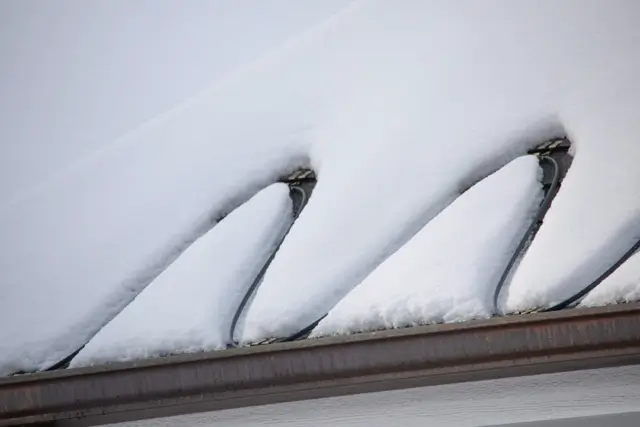
The best heat tape for roof and gutter de-icing is a self-regulating cable that adjusts heat output based on temperature. These cables work on all types of roof materials and automatically adjust the energy they consume based on outdoor temperatures. Constant-wattage cables cost less upfront but often fail within 1-2 years and only work on asphalt shingle roofs. For long-term ice dam prevention, a quality self-regulating system saves money despite the higher initial cost. Some self-regulating heat cables come with a ten-year warranty.
Roof heat tape prevents ice dams by creating melted channels through snow and ice along roof edges, in gutters, through downspouts and drains. The right system keeps water flowing away from your home instead of backing up under shingles and causing leaks.
Understanding the Two Types of Roof Heat Tape
Not all heat tape works the same. There are two fundamentally different technologies.
Constant-Wattage Heat Tape
Constant wattage cables stay at full power whenever plugged in, hence the name. They deliver a fixed 3-5 watts per foot regardless of surrounding temperatures. You’ll find these at hardware stores under brands like Frost King, EasyHeat, and Wrap-On. It’s essential to never allow these cables to overlap anywhere along the installation due to risk of electrical shorting.
Limitations:
- Cannot overlap or touch itself without risking fire
- Only safe on asphalt shingle roofs
- Stops working effectively below 15°F
- Not approved for use on flat roofs
- Draws maximum power 24/7 when plugged in
- Typically carries a 1-2 year warranty.
Self-Regulating Heat Tape
These cables automatically adjust heat output with changes in outdoor temperatures. A special conductive core asks for more electrical current when it’s cold and less when it warms up, hence the name ‘self-regulating’. These cable only use power needed for current conditions, making them significantly more efficient for typical roof and gutter and pipe freeze applications.
Key advantages:
- Safe to overlap
- Approved for all roof materials (metal, wood, rubber, flat roofs)
- Works in subzero temperatures
- Expected lifespan of 10+ years
- Energy-efficient operation
- Backed by 5-10 year warranties
The cost is roughly 2-3 times more than constant wattage cables of comparable lengths. After factoring in energy savings and longevity, they end up cheaper than replacing constant-wattage cables every couple of years.
Feature | Constant-Wattage | Self-Regulating |
Heat Output | Fixed (always max power) | Adjusts automatically with temperature |
Energy Use | High - draws full power 24/7 | Low - uses only what's needed |
Can Overlap? | No - not safe to overlap | Yes - safe to overlap |
Roof Types | Asphalt shingles only | All roof types |
Temperature Range | Fails below ~15°F | Effective to -20°F or lower |
Lifespan | 1-2 years | 10+ years |
Warranty | 1-2 years | 5-10 years |
100ft Cost | ~$75 | ~$300-400 |
The choice is clear if you need a permanent solution. Self-regulating cables cost more initially but deliver reliable performance for a decade. For those looking for a temporary, budget solution constant wattage may be a better option.
Top Heat Tape Products for Roofs
1. Heat Tape Pro (Roof & Gutter)
Heat Tape Pro is a commercial-grade self-regulating system with an industry-leading 10-year warranty. That’s five times longer than typical hardware store brands.
The cable adjusts from approximately 6 watts per foot at 50°F up to 10 watts per foot in freezing conditions. It’s UL-listed for all roof types, including metal, wood shake, rubber membrane, and flat roofs.
What sets it apart is the patented GlowCap indicator. The end cap has an LED that glows green when the cable is powered and working. The power plug has an integrated light too. This gives you instant visual confirmation that your system is running – a feature no other heat tape offers.
The cable is field-repairable if damaged. Instead of replacing an entire run, you can splice in a repair. Heat Tape Pro won’t overheat even if overlapped or buried under leaves. It’s designed for roof valleys, gutters, and downspouts without issue.
Installers in cold climates often use this cable exclusively. It’s built heavy-duty and expected to last well beyond its 10-year warranty with proper installation.
2. RayChem Self-Regulating Heat Cable
RayChem offers another premium option with a 10-year warranty. The cable features a durable, weather-resistant jacket that stays flexible in cold temperatures.
A notable design feature: the jacket doesn’t bubble or pull away from the core when bent. This prevents moisture ingress and cold-weather cracking that can shorten cable life.
RayChem cables work on all roof types and can be installed in temperatures down to 0°F. The specs and quality are comparable to Heat Tape Pro – both represent the top tier of self-regulating systems.
3. Frost King Roof De-Icing Cable
Frost King is the most common constant-wattage option at home improvement stores. Kits come in 30, 60, and 100-foot lengths, typically rated at around 5 watts per foot. A 100-foot kit costs roughly $60-100.
The cables are straightforward to install and include clips for mounting along roof edges and gutters. They can prevent ice buildup in mild winter conditions.
The limitations matter, though. Use only on asphalt shingle roofs. Never overlap the cable or let it cross itself. Performance drops significantly below 15°F. Expected lifespan is 1-2 seasons, reflected in the short warranty.
Monitor the cable regularly if you go this route. Keep it clear of leaves and debris. Use a timer or thermostat to control when it runs, since it draws full power constantly when plugged in.
This works as a short-term or entry-level solution. Plan to upgrade to self-regulating if you need reliable long-term protection.
4. EasyHeat and Similar Constant-Wattage Kits
EasyHeat (like the ADKS series) functions similarly to Frost King. These constant-wattage kits come with attached plugs in preset lengths, usually around 5 watts per foot output.
The installation requirements are the same: asphalt shingle roofs only, no overlapping, careful placement to avoid combustibles. Warranties run about one year.
All of these hardware store kits perform roughly the same. They’ll keep some ice clear from the eaves and help gutters drain. But they’re essentially disposable – expect to replace them every year or two.
Many homeowners eventually replace these with higher-grade systems. As one installer noted, “It’s better to put in a real system the first time.”
How to Choose the Right Heat Tape
Start with your roof type. If you have anything other than standard asphalt shingles – metal, wood, slate, rubber membrane – you need self-regulating cable. Constant-wattage isn’t safe for these materials.
Consider your climate. If temperatures drop below 15°F, constant-wattage cables won’t keep up. Self-regulating systems work effectively in subzero cold.
Think long-term. A self-regulating system costs 2-3 times more upfront but lasts 5-10 times longer. It also uses less electricity. The total cost over 10 years is lower than the cost of replacing cheap cables multiple times.
Look at the warranty. A 10-year warranty signals a manufacturer’s confidence in their product. A 1-2 year warranty tells you the cable isn’t built to last.
Check for useful features. Built-in indicators let you verify the system is working without going outside. Field-repairable cables save money if damage occurs. Compatibility with accessories makes installation easier.
For any serious ice dam problem, professionals recommend a high-quality self-regulating cable. The upfront investment pays off through years of reliable performance and lower energy costs.
Ready to Protect Your Roof?
Choosing quality heat tape saves you money and hassle over time. A well-made self-regulating system handles whatever winter throws at it without constant attention.